
Mission District Cultural Heritage Talk and Tour
CANA – Cultura y Arte Nativa de las Américas
683 Florida Street San Francisco, CA 94110-2023 United States
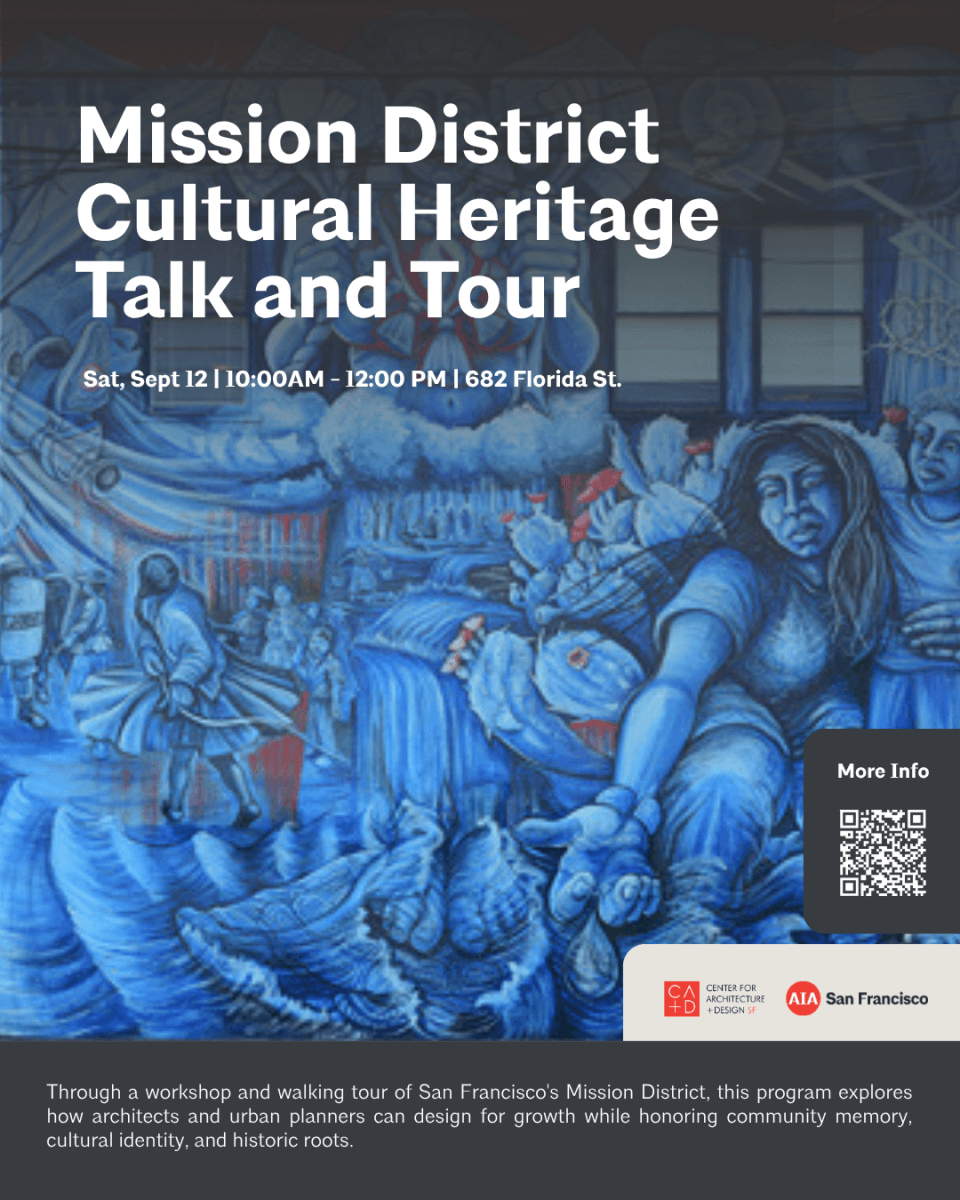
Preservation and Perseverance: Understanding Latino Cultural Space in San Francisco's Mission District
As architects, planners, and designers shape the built environment, it is important to recognize that neighborhoods are more than buildings and streets—they are cultural landscapes shaped over generations by the people who live, work, worship, create, organize, and celebrate within them.
This workshop explores how cultural identity, community memory, language, art, and tradition shape place, and how design professionals can work responsibly in culturally significant neighborhoods experiencing change.
Drawing on Chicana scholar Emma Pérez's concept of sitio y lengua (place and language), the program examines how stories, traditions, murals, festivals, local institutions, and everyday interactions transform physical spaces into places of belonging.
The Mission District serves as a case study, illustrating how Latino, Chicano, Indigenous, immigrant, and working-class communities have shaped the neighborhood through businesses, public art, cultural institutions, civic engagement, and community traditions, making it one of the nation's most significant centers of Latino cultural expression.
The workshop also examines the impacts of development, rising housing costs, and displacement on cultural continuity. As residents, artists, businesses, and community institutions are displaced, neighborhoods risk losing the relationships, traditions, and memories that define them.
Rather than asking whether neighborhoods should change, the workshop asks how growth can respect the cultural foundations established by generations of residents. Through discussion, storytelling, and a guided tour of Balmy Alley, participants will explore how architecture, planning, and preservation can help sustain neighborhood identity by recognizing cultural heritage as an essential part of the built environment.
Mission District Walking Tour
Following the workshop, participants are invited to join a guided walking tour of Balmy Alley, one of the most significant collections of community murals in the United States.
Located in the heart of San Francisco's Mission District, Balmy Alley has served as an important center of muralism for more than four decades. Its walls tell stories of immigration, Indigenous heritage, labor struggles, international solidarity movements, neighborhood activism, cultural identity, and community resilience. Together, these murals create a powerful visual record of the Mission District's evolving history and the people who have shaped it.
The Balmy Alley Walking Tour will have introductory remarks by Dr. Carlos B. Cordova and Tirso González Araiza, who will provide historical context on the Mission mural movement, Balmy Alley's role in documenting community history, and the significance of murals as expressions of cultural memory and resistance.
Participants will then divide into groups of approximately 15 people. Dr. Carlos B. Cordova and Lucía González Ippolito will lead separate tours through Balmy Alley, sharing insights into the artists, murals, community stories, and cultural traditions that transformed this historic alley into one of the nation's most important cultural landscapes.
Agenda:
10:00am-11:30am Conversation at CANA
11:30am-12:00pm Lunch Break + Walk to Balmy Alley
(Participants can bring lunch or pick up lunch from a local vendor)
12:00pm-1:30pm Calle 24 Historic District & Balmy Alley Walking Tour
Hosted by the Center for Architecture + Design in collaboration with AIASF. While registration is processed through AIASF, 100% of ticket proceeds directly support the Center for Architecture + Design's public programs, exhibitions, and educational initiatives, helping us advance design awareness and foster meaningful conversations about the built environment.

Anne Cervantes
Moderator | Architect, Urban Planner, Historic Preservationist
Anne Cervantes is a San Francisco architect, urban planner, historic preservationist, and community advocate with more than 30 years of experience in architecture, planning, and cultural resource preservation. She is Principal of Cervantes Design Associates, a founding member of the San Francisco Latino Historical Society, and a member of the leadership and research team for the Citywide Latino Historic Context Statement, Nuestra Historia: Documenting the Chicano, Latino, and Indigenous Contributions to the Development of San Francisco. Her work focuses on documenting Latino cultural landscapes, preserving historic resources, and advancing community-based approaches to architecture, planning, and historic preservation.
Dr. Carlos B. Cordova
Professor Emeritus, Historian, Researcher
Dr. Carlos B. Cordova is Professor Emeritus of Latina/Latino Studies at San Francisco State University and one of the Bay Area's leading scholars of Latino history, migration, community development, and cultural preservation. He is a co-founder of the Mission Cultural Center for Latino Arts and the San Francisco Latino Historical Society and served as lead researcher, historian, and project director for the Citywide Latino Historic Context Statement, Nuestra Historia: Documenting the Chicano, Latino, and Indigenous Contributions to the Development of San Francisco. His scholarship and public history work have significantly advanced understanding of San Francisco's Latino and Central American communities.
Lorraine García-Nakata
Artist, Cultural Leader, and Historian
Lorraine García-Nakata is an artist, arts and cultural specialist, and community leader. A member of the Royal Chicano Air Force (RCAF) and co-founder of the San Francisco Latino Historical Society, she has served as Organizational Arts Grants Administrator for the State of California, Arts and Humanities Program Officer for the Marin Community Foundation, Commissioner of the San Francisco Arts Commission, and Federal Commissioner for the National Museum of the American Latino Commission. Her work has advanced cultural equity, public art, historic preservation, and Latino representation for more than five decades.
Daniel Galvez
Muralist and Public Artist
Daniel Galvez is a nationally recognized Chicano muralist, painter, and public artist whose work has become an enduring part of California's cultural landscape. He is best known as the creator of the iconic Carnaval Mural at 24th Street and South Van Ness Avenue, one of the Mission District's most celebrated cultural landmarks. For decades, Galvez has used public art to tell community stories and document the cultural life, history, and aspirations of California's diverse communities.
Juana Alicia
Muralist, Educator, and Activist
Juana Alicia is an internationally acclaimed Chicana muralist, printmaker, educator, and activist whose work explores social justice, environmental stewardship, women's rights, Indigenous knowledge, and community empowerment. As a member of the pioneering Mujeres Muralistas movement, she helped expand opportunities for women in public art and became one of the most influential muralists of her generation. Her landmark works include La Llorona's Sacred Waters in the Mission District and Maestrapeace at San Francisco's Women's Building.
Rodrigo Ehecatl Durán
Executive Director, Carnaval San Francisco
Rodrigo Ehecatl Durán is Executive Director of Carnaval San Francisco, producer of California's largest and longest-running multicultural parade and festival. A native San Franciscan and cultural advocate, he has dedicated his career to supporting cultural preservation, community engagement, and equitable representation. Through Carnaval San Francisco and his previous work with the Calle 24 Latino Cultural District, Durán has helped strengthen and celebrate the Latino, Caribbean, and African Diaspora traditions that define San Francisco's cultural life.
Tirso González Araiza
Muralist, Sculptor, Educator, Curator, and Cultural Activist
Tirso González Araiza is a graphic artist, sculptor, muralist, educator, and cultural activist born in Mérida, Yucatán, Mexico. Since arriving in San Francisco in the 1980s, he has been an important contributor to the city's Latino arts movement through his work with Mission Gráfica, public art projects, arts education, and community cultural programming. A co-founder of Asociación Mayab and longtime curator of Balmy Alley mural projects, González Araiza has helped preserve and expand one of the nation's most significant collections of community murals. He is also the co-creator of the celebrated Mission Makeover mural with his daughter, muralist Lucía González Ippolito.
Lucía González Ippolito
Muralist, Cultural Organizer, and Community Advocate
Lucía González Ippolito is a Mission District muralist, cultural organizer, and community advocate whose work explores social justice, neighborhood identity, displacement, and cultural preservation. The daughter of acclaimed muralists Juana Alicia and Tirso González Araiza, she continues the Mission's tradition of community muralism through her artwork and public engagement. She is co-founder and curator of Lovers Lane, an annual Balmy Alley arts and community festival that brings together artists, residents, families, and cultural organizations to celebrate the Mission District's creative heritage and community spirit.
Part of the 23rd Annual Architecture + the City Festival
This event is part of San Francisco’s annual citywide celebration of architecture, design, and the built environment.
Explore the full festival program →
SPONSOR OPPORTUNITIES
Join San Francisco’s premier celebration of architecture, design, and community. This month-long festival offers dynamic ways to engage with the built environment through tours, talks, and special events. Align your brand with innovation, creativity, and civic dialogue—explore unique sponsorship opportunities today.
Thank you:
A special thank you to Anne Cervantes for organizing and providing for this program!
Support our partners:
Mission Mural Restoration Project
The murals of the Mission District are among San Francisco's most important cultural resources. They serve as living archives documenting immigration, labor history, social justice movements, community struggles, cultural traditions, and neighborhood identity.
To support ongoing restoration and preservation efforts, donations may be made through:
Brava for Women in the Arts
2781 24th Street
San Francisco, CA 94110
Phone: (415) 641-7657
www.brava.org
Please note on your donation:
"Juana Alicia – Mission Mural Restoration Project"
CASA DE CARNAVAL RECORDING STUDIO
Donate:
https://givebutter.com/CANArecordingstudio
CANA is launching a new recording studio at its recently established community center, Casa de Carnaval, creating a dedicated space where youth, artists, musicians, culture bearers, and community members can collaborate, create, and amplify their voices.