
Inhabited Mud - Generative Earthen Housing
Organization Overview
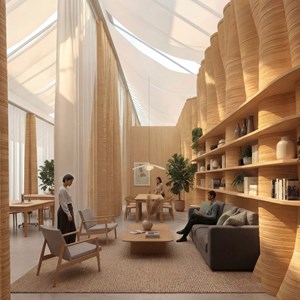
Honoring the region’s long tradition of earth architecture, the houses blend
site mud with plant-based fibers, channeling the cooling mass while
delivering made-to-order living spaces that can one day dissolve
harmlessly back into earth. Inhabited Mud is organized around three
elements—an exterior wall system, an interior wall system, and movable
rooms—enabled by robotic 3D printing for making and generative AI–
assisted design workflow for customization.
The exterior wall system defines the climate boundary where house and
natural environment meet. Colorado’s wind-sculpted canyon walls—leaning
strata that self-shade—sparked the idea. Different types of elements are
embedded in the wall so that the wall acts as a door, window and vent at
the same time.
The interior wall system is the service spine. It houses all MEP services,
appliances and fixed furniture. A generative-AI lets users choose wall-
embedded components and layouts for quick, tailored configurations.
The movable pod system consists of flexible rooms—workstation, nursery,
sleeping space—that reposition as needs evolve. 3D-printed in sawdust,
they are soft, lightweight, and mounted on wheels, so one or two people
can roll them to a new location and lock them in place. The interiors and
shell features are also customizable through the same AI workflow.
Together, the three systems and two tools outline a low-carbon, site-
sourced house that is highly customizable, community-minded, and ready to
adapt over time.
site mud with plant-based fibers, channeling the cooling mass while
delivering made-to-order living spaces that can one day dissolve
harmlessly back into earth. Inhabited Mud is organized around three
elements—an exterior wall system, an interior wall system, and movable
rooms—enabled by robotic 3D printing for making and generative AI–
assisted design workflow for customization.
The exterior wall system defines the climate boundary where house and
natural environment meet. Colorado’s wind-sculpted canyon walls—leaning
strata that self-shade—sparked the idea. Different types of elements are
embedded in the wall so that the wall acts as a door, window and vent at
the same time.
The interior wall system is the service spine. It houses all MEP services,
appliances and fixed furniture. A generative-AI lets users choose wall-
embedded components and layouts for quick, tailored configurations.
The movable pod system consists of flexible rooms—workstation, nursery,
sleeping space—that reposition as needs evolve. 3D-printed in sawdust,
they are soft, lightweight, and mounted on wheels, so one or two people
can roll them to a new location and lock them in place. The interiors and
shell features are also customizable through the same AI workflow.
Together, the three systems and two tools outline a low-carbon, site-
sourced house that is highly customizable, community-minded, and ready to
adapt over time.


Award
Award Recipient
Category
2026 Unbuilt
Project Team
Submitting Firm: Qiu + Fu
Architects: Shenglu Qiu, Zhongyuan Fu
Architects: Shenglu Qiu, Zhongyuan Fu
Jury Comments
Forward-looking and architecturally imaginative, Inhabited Mud: Generative Earthen Housing earns recognition for expanding the conversation around material innovation and low-carbon design. Its exploration of earthen construction and new fabrication methods suggests a compelling model for how materials, form, and inhabitation come together in the future.